
GLP-2 stands for glucagon-like peptide-2. This is a hormone-like peptide that is produced in the intestine. It is released after eating.
GLP-2 biologically belongs to the same family as GLP-1. However, they do not have the same function. GLP-1 is mainly discussed in relation to appetite, satiety, blood sugar, and weight loss. GLP-2 is mainly discussed in relation to intestinal function, intestinal repair, and nutrient absorption.
That's why GLP-1 and weight loss Another topic than GLP-2. Both terms sound alike, but the mechanism of action is different.
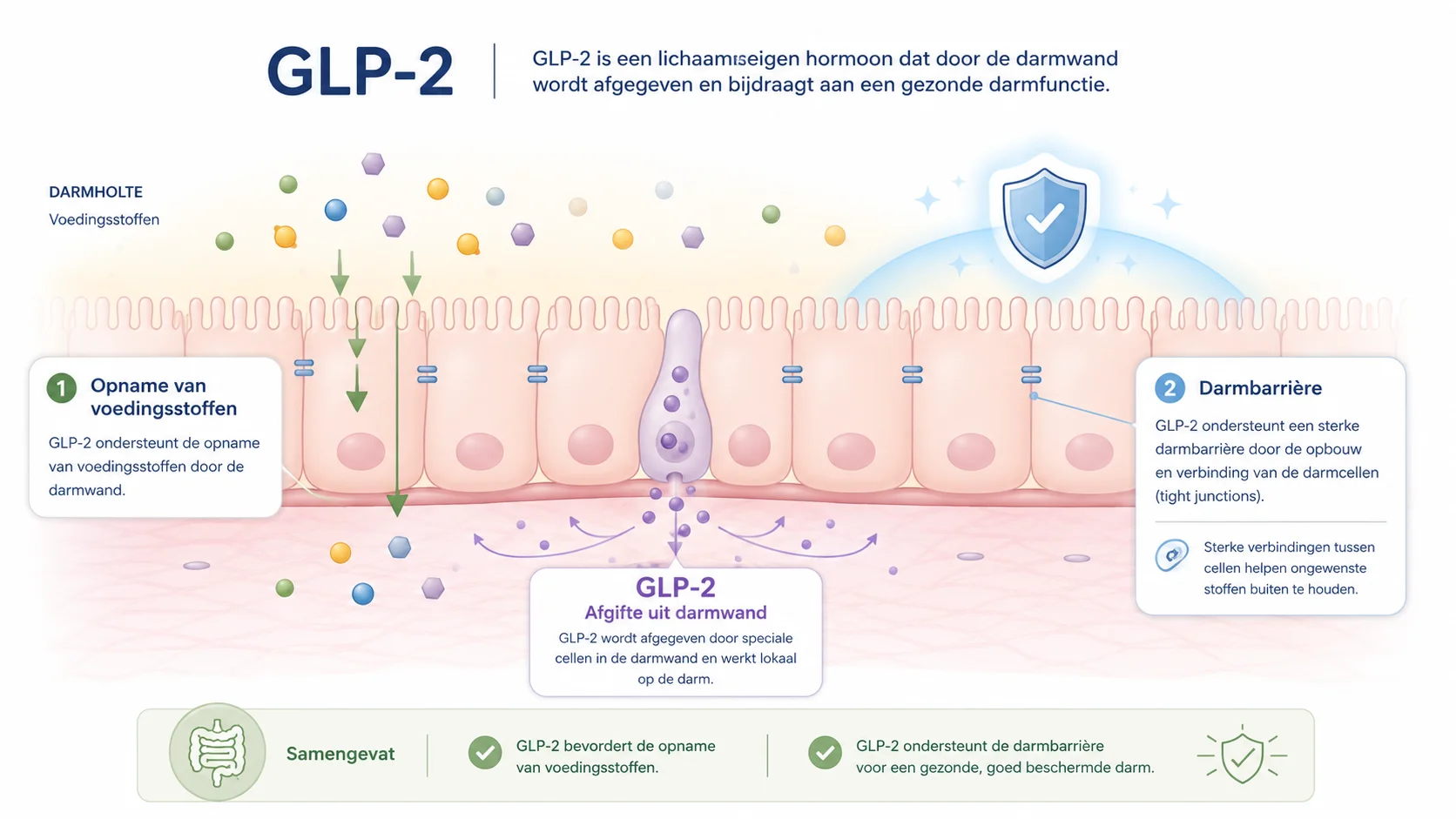
GLP-2 primarily works in and around the intestines. It supports processes related to the intestinal wall and nutrient absorption. Therefore, GLP-2 is mainly seen as an intestine-focused hormone.
The intestinal wall has an important function. It helps absorb nutrients. The intestinal wall also forms a barrier between the contents of the intestine and the rest of the body.
GLP-2 is linked to supporting this gut barrier. It is also being investigated for its role in gut repair and the structure of the intestinal wall.
GLP-2 can affect nutrient and fluid absorption. This makes it particularly relevant in medical situations where the intestines are not functioning optimally.
This is important for athletes to understand well. GLP-2 is not about directly lowering appetite. It's mainly about the gut and absorption. That's a different starting point than with semaglutide for weight loss or tirzepatide and weight loss.
GLP-1 and GLP-2 are often mentioned together. This is because they are both produced in the intestine. However, their functions are different.

GLP-1 plays a role in satiety, appetite, gastric emptying, and blood sugar. Therefore, GLP-1 agents are often discussed in the context of weight loss and obesity.
Common topics within this group include Ozempic, Mounjaro, semaglutide and tirzepatide.
GLP-2 has a different role. It is mainly linked to the intestinal wall, intestinal barrier, intestinal blood flow, and nutrient absorption. Therefore, GLP-2 is less directly associated with weight loss.
Are you mainly looking for information about appetite suppression and fat loss? Then topics such as GLP-1, semaglutide and tirzepatide better.
GLP-2 is a real biological term. It refers to glucagon-like peptide-2. GLP-3 is different.
The term GLP-3 is often used online in connection with new generation weight-loss drugs. You'll particularly see this term used with retatrutide. However, GLP-3 is not an official primary medical term like GLP-1 and GLP-2.
At GLP-3 and new weight loss drugs usually involves agents that work on multiple receptors simultaneously. An example of this is retatrutide. This is often discussed as a triple agonist because it acts on GLP-1, GIP, and glucagon.
GLP-2 is not a standard weight-loss medication. It does not work the same way as agents that affect appetite and satiety.
When losing weight, the focus is mainly on methods that can reduce energy intake. Think of GLP-1-related medications. GLP-2 is mainly discussed due to its effect on gut function.
Therefore, it is important not to view GLP-2 as a normal route for fat loss. Those looking to lose weight usually turn more quickly to GLP-1, Mounjaro, Ozempic or Fat burners and fat loss.
GLP-2 is primarily researched and used in relation to intestinal problems. A well-known medical application is in people with short bowel syndrome, where the intestine does not function well enough to absorb sufficient nutrients and fluids.
A GLP-2 analog, such as teduglutide, is used in a medical context for specialized intestinal care. This is done under the guidance of doctors. It is not a substance that you simply use for weight loss, cutting, or fat loss.
A GLP-2 analog is a substance that resembles natural GLP-2 in the body. The goal is to mimic or prolong certain effects of GLP-2.
GLP-2 analogs are primarily about gut function and absorption. This is therefore different from a classic fat burner or a substance that mainly reduces hunger.
Athletes often look for information about substances that can aid in fat loss, recovery, or performance. With GLP-2, it is important to remain realistic.
GLP-2 is not a typical cutting tool. It is also not a product directly intended for burning fat. Its action is primarily in the gut. Think about absorption, fluid balance, and gut function.

For athletes who want to lose weight, nutrition, training, sleep, and recovery are the foundation. After that, one can delve into topics such as fatburners, T3, T5 of GLP-1-related agents. GLP-2 aligns more with knowledge about the gut than with direct fat burning.
GLP-2 and GLP-2 analogs can have side effects and risks. Guidance is important, especially for medical applications.
Common side effects of GLP-2 analogs include abdominal discomfort, nausea, bloating, and injection site reactions. Other considerations may include fluid balance, intestinal obstruction, gallbladder, pancreas, and polyps.
This does not mean that everyone will experience these complaints. However, it does mean that GLP-2 is not a subject to be taken lightly. Do not use substances if you do not fully understand what they do. If you have doubts, seek advice from an expert.
The confusion primarily arises because GLP terms are very similar to each other. They are also often used interchangeably online.
GLP-1 is known for weight-loss drugs. GLP-2 sounds similar but has a different function. GLP-3 is used online for new drugs like retatrutide, but it is not an official hormone name.
That's why it's smart to look at these terms separately. For example, first read more about GLP-1 If you are looking for appetite and weight loss. Look at GLP-3 if you want to know more about new generation weight loss drugs. And use GLP-2 especially as an explanation of intestinal function and absorption.
 Dutch Dutch
  English